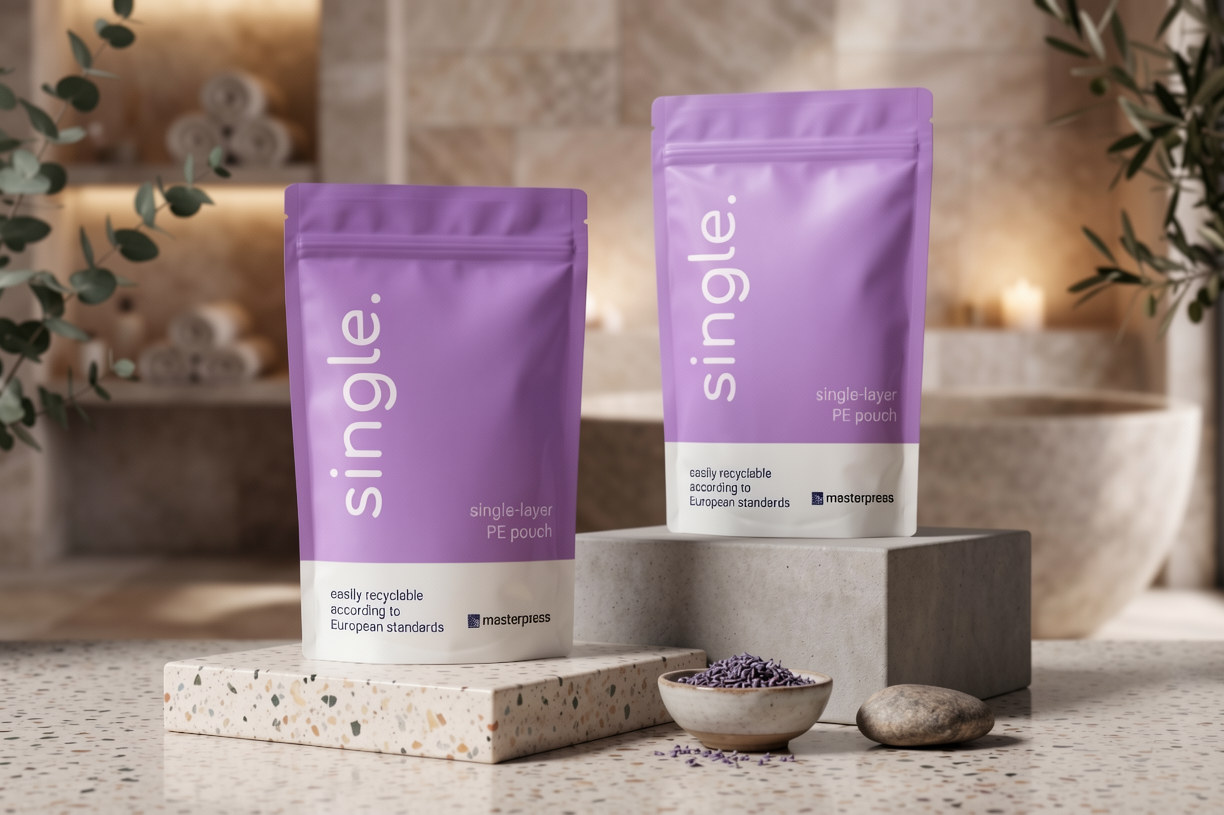


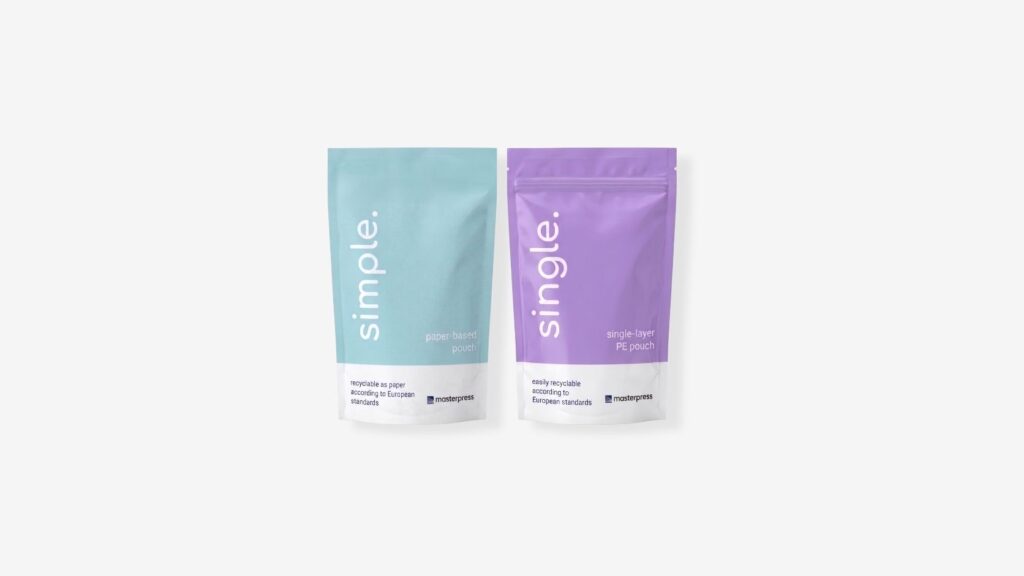
The latest investment in an in-house pouch-making line enables Masterpress to deliver high-barrier, PFAS-free pouches with over 90% paper content and recyclable single-layer PE structures, offering brand owners a fast track to PPWR compliance.
Masterpress, a European provider of high-quality label and packaging solutions, has announced the installation of a Karlville Swiss pouch-making machine at its Białystok production site.
The investment significantly expands the company’s sustainable packaging portfolio to meet accelerating market demand for circular economy solutions and compliance under the EU’s Packaging and Packaging Waste Regulation (PPWR).
By bringing pouch-making in-house, Masterpress connects existing digital and flexographic printing capabilities with a new pouch-forming line. As a result, surface-printed paper- and plastic-based materials can move directly from printing to pouch formation without the need for an intervening lamination or curing stage, reducing production lead times.
Installed in August 2026, the machine became fully operational in September following operator training and trials with different materials, pouch formats and sizes.
“We see pouches as the future of sustainable packaging for many FMCG products because of their low material weight and lower carbon footprint compared with glass, rigid plastic and metal formats,” says Jakub Pędziński, Business Development Leader – Pouches, Masterpress. “This investment directly responds to the growing demand from brand owners, retailers, and consumers for high-performance packaging that balances product protection, shelf life and end-of-life recyclability.”
Paper pouches with more than 90% paper content and high-barrier protection
With the new Karlville Swiss, Masterpress can now produce pouches from material containing more than 90% paper and more than 95% bio-based content. The material is suitable for food contact and a range of dry food and non-food applications, including pet food, spices and food supplements. Crucially for health and environmental safety, the material is also free from per- and polyfluoroalkyl substances (PFAS) and polyvinylidene chloride (PVDC).
For packaging applications where barrier performance is critical, the material also delivers an ultra-high barrier against oxygen and water vapour, helping to protect packaged products and support shelf life. Under the specified test conditions, its oxygen transmission rate (OTR) was below one cubic centimetre per square metre per day, while its water vapour transmission rate (WVTR) was below one gram per square metre per day.
Recyclability testing adds further weight to the material’s packaging credentials. Testing under the Confederation of European Paper Industries (CEPI) method confirmed that the material is suitable for recycling in standard paper mills, while it also achieved Level A under the Aticelca 501 paper recyclability assessment. These results apply to the material itself, as the final printed, pre-made pouches will undergo recyclability testing.
PPWR readiness and operational flexibility across materials, formats and production volumes
Alongside the new paper-based and single-layer PE structures, the new machinery can convert both digitally and conventionally printed standard laminates and single-layer PE- or PP-based structures. Formats include two-side-seal, three-side-seal and stand-up pouches, with or without zippers. This includes easy-opening zippers designed in line with future requirements under PPWR.
Designed to support short, medium and long production runs, the line allows brands to test and pilot new materials and pouch formats without committing to large volumes or investing in their own costly pouch-making equipment. This operational agility is supported by guided, recipe-based set-up, quick-change systems and a low scrap rate during start-up and roll changes.
“Our focus is on advancing single-layer structures intended for either the paper or plastic recycling stream,” Pędziński adds. “At the same time, the technology allows us to evaluate new innovative materials and accommodate a wide range of production volumes.”
The Karlville Swiss machine uses eight independently controlled servo motors to manage material feeding, sealing, cooling and cutting, enabling operators to control material tension at different stages and fine-tune the process for single-layer and paper-based structures.
Aligned with Masterpress’s sustainability goals, the line is designed to support low-maintenance operation and energy-efficient production, with low specified energy consumption of just 5-7 kilowatt-hours (kWh).